

LLM Engineering 101
This course teaches how to build reliable products on top of large language models: prompting, tool calling, retrieval, agents, evaluation, safety, and keeping cost and latency under control.
 Ex-LinkedIn
About this course
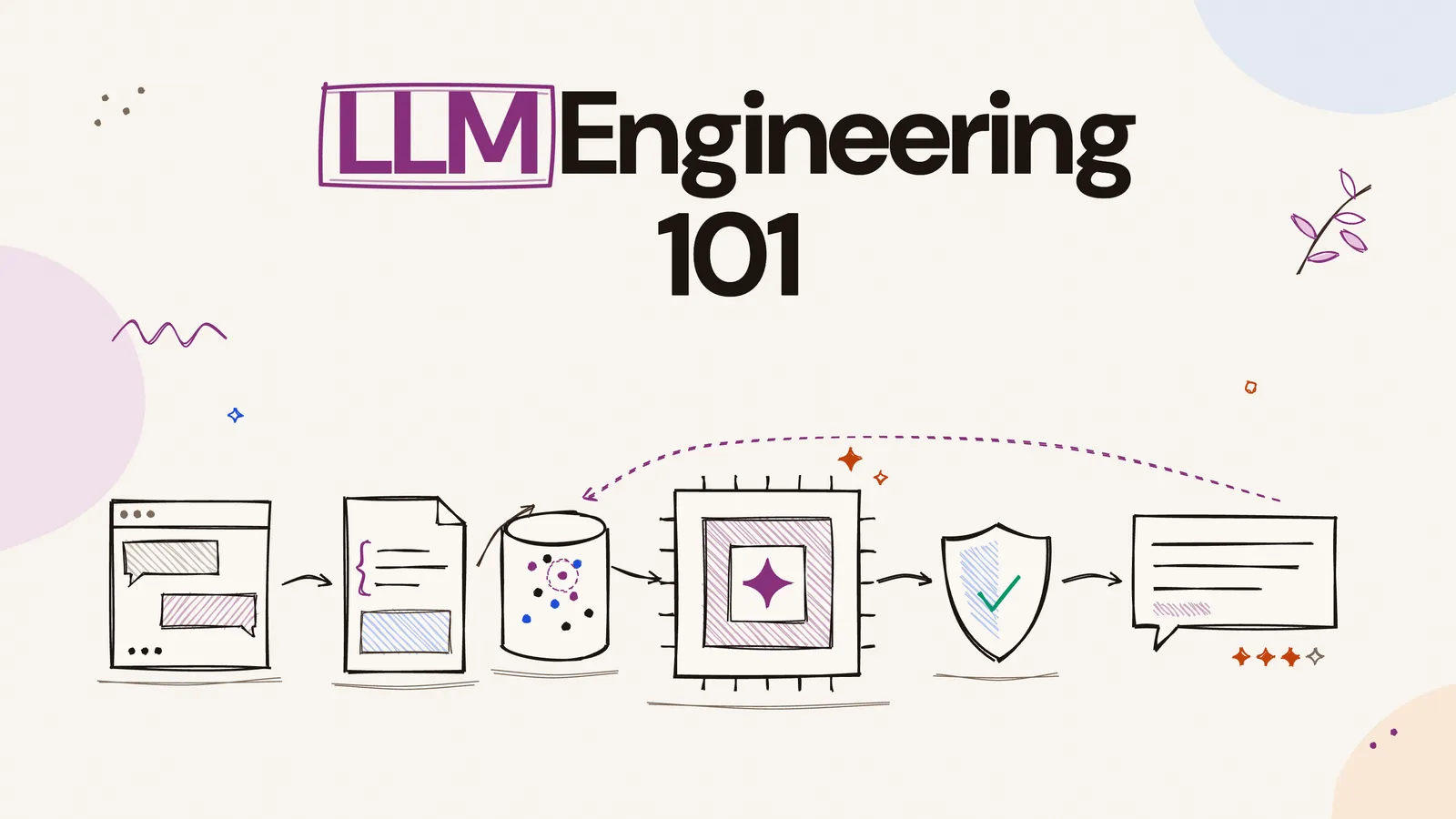
Most AI features today are built on a pretrained large language model rather than a model trained from scratch. That moves the hard work. You no longer collect labels or engineer features. Instead you decide what goes into the model's context, how to get output your code can trust, how to judge answers that have no single right form, and how to keep the feature safe, fast, and affordable. This course covers building reliable products on top of LLMs, one decision at a time.
Each section takes one question that AI engineer and forward-deployed engineer interviews actually ask and answers it as a standalone topic, with a small running example.
What You Will Learn
- What tokens, context windows, and sampling mean for your design, and how to pick a model
- How to write, version, and improve prompts
- How to get structured output and let the model call your tools
- How to ground answers in your own documents with retrieval-augmented generation
- When to build an agent instead of a fixed workflow, and how to keep it reliable
- How to evaluate open-ended output and catch regressions
- How to defend against prompt injection, jailbreaks, leakage, and hallucination
- How to estimate and cut token cost and latency
- When fine-tuning is worth it, and when prompting or retrieval is enough
- How to ship, trace, and monitor an LLM feature in production
- Optional: taking an LLM project from a customer's first ask to production
- Optional: when several cooperating agents beat one
- Optional: when to self-host an open-weight model and how to size it
How This Course Works
Each section starts with the simplest thing that could work, such as one prompt, one model call, or pasting a document into the context. Then it shows where that breaks, and adds the next idea only when a specific failure calls for it.
The model is treated as a component you call, not something you train. The sections teach capabilities and trade-offs that hold across model releases rather than any one provider's current lineup.
Who This Course Is For
This course is for software engineers moving into AI engineering or forward-deployed roles, and for ML engineers who are new to building on LLMs. You should be comfortable with APIs and basic system design. You don't need a deep learning research background.
This is not a course on how transformers are trained, and it does not reteach the classic ML lifecycle covered in Machine Learning System Design 101.
Chapters
Core
- 1
LLM Fundamentals for Engineers
30 min
- 2
Prompt Design
30 min
- 3
Structured Output and Tool Calling
50 min
- 4
Retrieval-Augmented Generation
45 min
- 5
Agents
45 min
- 6
Evaluating LLM Applications
40 min
- 7
Guardrails and Safety
45 min
- 8
Cost and Latency
25 min
- 9
Prompting, RAG, or Fine-Tuning
25 min
- 10
LLM Applications in Production
40 min