

What OpenAI Actually Tests — And What Gets Candidates Rejected (2026)
What the process actually selects for, and what gets candidates rejected
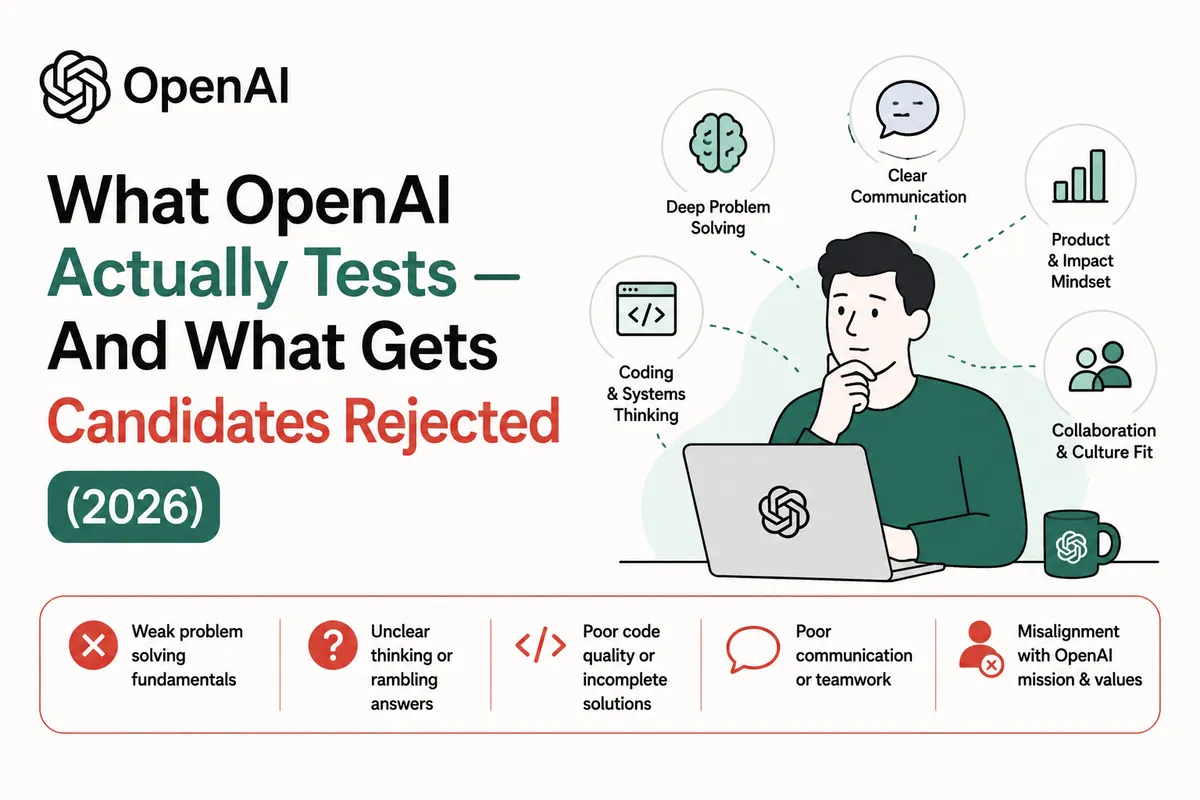
Adequately passing every round at OpenAI is not enough to advance. The hiring committee requires 2+ strong hire ratings, so a distribution of "close call" signals from multiple interviewers does not accumulate into a pass: it resolves as rejection, typically with a 6-month minimum before reapplying. Most candidates who receive the "close call" response interpret it as a near-miss with reconsideration pending. It is a rejection with no near-term appeal window.
What They Actually Evaluate
Based on candidate-reported experiences analyzed by Hack2hire
Design-Heavy Coding
Candidates who approach OpenAI's coding rounds as algorithmic pattern-matching exercises report losing time early, recognizing that the questions don't fit any known template from public forums or study materials. A substantial portion of the coding problems are novel and unreported: candidates encounter them for the first time in the room, with no prior community exposure to fall back on. The evaluation targets reasoning about resource constraints and API contracts, not algorithmic efficiency or template recognition. Problems require multi-part decomposition from scratch. Interviewers assess whether the candidate can frame the problem's boundaries before writing any code: the resource model, the API surface, the state transitions. Candidates who begin implementation immediately, without establishing the design frame, report that follow-up constraints expose gaps in their initial approach and create rework pressure under time limits.
System Design at Scale
Distributed systems reasoning and operational tradeoffs are the evaluation target in OpenAI's system design round, not functional design coverage. The depth and direction of the conversation vary based on one structural factor: when the assigned interviewer built the actual system being designed, the round bypasses functional requirements and moves directly to scalability and operational decisions. Candidates who plan to establish functional coverage before exploring depth report being redirected earlier than their preparation assumed, and some don't complete all functional requirements within the time limit. Topics in this round span a wide range: communication infrastructure, payment systems, AI platform architecture, developer tooling, and location services. Domain-expert interviewers expect depth that exceeds standard system design preparation, and outcomes correlate more with the candidate's ability to reason under specificity than with general case coverage.
ML Implementation (MLE Roles)
The MLE coding assessment at OpenAI requires debugging large-scale production codebases and computing matrix operation complexity on the spot, under time pressure. Theoretical ML knowledge provides no buffer: candidates without hands-on library proficiency run out of time before reaching the algorithmic layer of the problem, and the gap manifests in the first portion of the round rather than the last. The evaluation targets implementation familiarity specifically: the ability to read, diagnose, and modify production-scale ML code, not the ability to explain how the underlying algorithms work. Candidates who have strong theoretical ML foundations but limited hands-on framework experience consistently report not completing the problem, regardless of their conceptual depth.
Behavioral and Philosophy Alignment
Candidates who are strong on coding but generic on OpenAI's behavioral and AI philosophy questions frequently don't clear the 2+ strong hire threshold. The behavioral and philosophy alignment round carries the same hiring committee weight as technical coding and system design rounds: a weak signal here applies the same committee penalty as a weak signal in system design. The round covers standard leadership and collaboration questions, but also includes OpenAI-specific questions on AI impact and what the candidate considers a meaningful benefit to humanity. These philosophy questions are not warm-up material and are not scored on a softer standard than the technical rounds. Candidates who treat this round as a formality find the committee outcome does not reflect the technical strength they produced elsewhere in the process.
What They Don't Test
- Algorithmic pattern recognition speed: coding rounds evaluate design-first reasoning and multi-part problem decomposition, not template recognition from public problem banks
- Theoretical ML knowledge in isolation: MLE rounds test hands-on implementation proficiency under time pressure; conceptual fluency does not substitute for library familiarity
- Individual round pass/fail scores: the hiring committee aggregates signals across all rounds and applies a 2+ strong hire threshold, not a per-round minimum
- Functional design completeness in system design: depth of operational and scalability reasoning is the primary evaluation target, not requirement or diagram coverage
The Real Filter
OpenAI's hiring committee requires 2+ strong hire ratings. "Close call" signals from multiple rounds do not aggregate to a pass: each produces a non-strong-hire signal, and the total count does not reach the threshold regardless of how many rounds the candidate covers adequately. The behavioral and philosophy alignment round is the most commonly underweighted source of non-strong-hire signals in the candidate report dataset. Candidates who produce strong technical performance across coding and system design but generic behavioral and philosophy responses don't reach the committee threshold. The committee outcome is structurally identical to a technical failure: the same "close call" response and 6-month minimum before reapplying, with no communication identifying which rounds produced the non-strong-hire signals. The hiring committee does not differentiate its response by where the shortfall occurred.
Data Source
Based on 14 firsthand interview reports, collected 2025-2026.
FAQ
Is OpenAI a good place to work as a software engineer?
Candidate reports describe an environment where engineers work directly on frontier AI systems and infrastructure. The interview reflects the technical environment: problems are novel, system design discussions go deep quickly, and behavioral round scores apply the same hiring committee weight as technical rounds.
What is OpenAI's engineering culture like?
OpenAI's engineering culture is mission-driven and research-adjacent. The behavioral round explicitly evaluates candidates' views on AI impact and benefit to humanity, placing philosophy alignment at the same hiring committee weight as coding and system design performance.
How hard is it to get a job at OpenAI?
Most rejections trace to an insufficient number of strong hire ratings rather than outright failure in one round. Candidates who adequately pass each round individually often don't reach the 2+ strong hire threshold the hiring committee requires, making aggregate signal distribution the actual gate.
What does OpenAI look for in software engineering candidates?
OpenAI evaluates design-first thinking in coding, distributed systems reasoning under operational constraints in system design, and for MLE roles, hands-on ML library proficiency rather than theoretical knowledge. Behavioral and AI philosophy alignment carries the same committee weight as technical rounds and is commonly underweighted in preparation.
OpenAI-specific question patterns are indexed at hack2hire.com.