

What Databricks Actually Tests — And What Gets Candidates Rejected (2026)
What the process actually selects for, and what gets candidates rejected
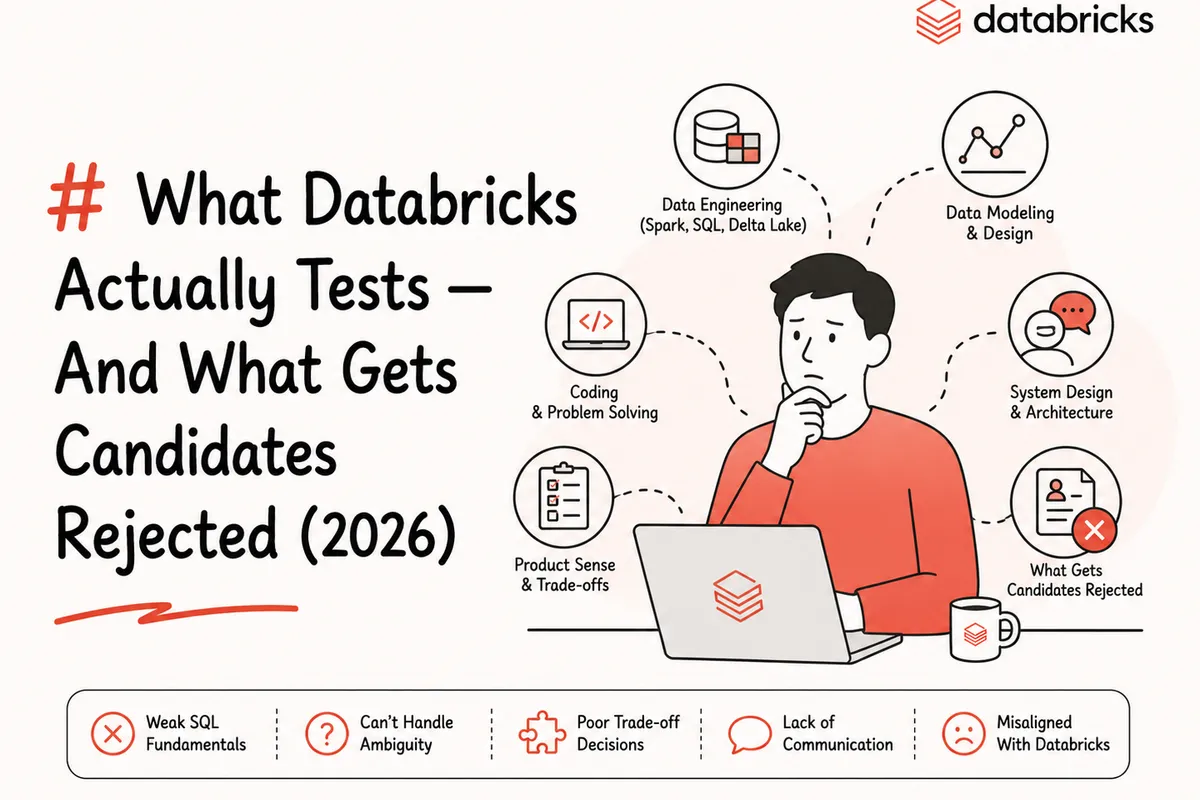
Databricks's question pool is publicly documented and broadly studied. The actual filter isn't question familiarity but constraint clarification: candidates who assumed problem details without explicitly confirming have failed on questions they recognized going in.
What They Actually Evaluate
Based on candidate-reported experiences analyzed by Hack2hire
Algorithm and Data Structures
The most common coding failure at Databricks is losing a question the candidate had seen before. Two 45-minute coding rounds, run by different interviewers, each follow a consistent structure in reported accounts: a base problem is posed, solved to completion with complexity analysis, and then extended into a variant that introduces an optimization target or a new constraint. Both rounds evaluate the same three phases: framing the problem and confirming constraints, implementing the solution, and running through test cases before the round ends. What earns signal across both rounds is the same: explicit constraint confirmation before any code is written, and a correct implementation with edge case coverage and a completed testing phase.
The failure pattern concentrates in the follow-up variant, not the initial problem. Candidates who solved the base problem correctly then moved into the follow-up assuming the constraints matched a version they'd encountered elsewhere. Implementations built on those assumptions produced wrong solutions. Running out of time before reaching the testing phase has also been cited in rejection accounts, independent of implementation correctness. In multiple reported rejections, the specific failure was a constraint-related sub-problem that came after a correct base solution, not a failure on the base problem itself.
System Design
Covering distributed infrastructure and application systems, the Databricks system design round runs 60 minutes and evaluates the ability to drive a complete design sequence from requirements through fault tolerance. Reported problem domains span communication infrastructure, file storage and synchronization, payment processing, and business application design including API modeling. Coverage completeness across the full design sequence earns signal: functional requirements, non-functional requirements, capacity estimation, API and schema design, and fault tolerance and scaling decisions. Candidates who moved directly to architecture without first scoping requirements and estimating capacity were noted as missing key evaluation steps in multiple accounts.
The depth of trade-off probing increases with candidate level. Senior and staff candidates reported more probing on architectural alternatives and consistency versus availability tradeoffs, including how the design degrades under failure scenarios. Those at senior or staff level may also encounter a second architecture round added to the onsite, covering a different problem domain with the same full-sequence expectations.
Behavioral
Databricks's behavioral round covers 4 to 5 topics in 45 minutes, with 2 to 3 questions per topic. The format is structurally distinct from in-depth single-scenario behavioral interviews: the interviewer moves through multiple professional themes in one session rather than reconstructing a single project narrative in depth. Topics reported include conflict handling, the hardest professional challenge faced, the biggest professional mistake, and feedback the candidate received and disagreed with. Candidates who gave detailed answers to early topics reported running short on time before the later topics were covered, leaving those topics partially or fully unanswered in the session.
What They Don't Test
- Rote solution recall: knowing a base problem from prior preparation doesn't correlate with passing; the filter is constraint clarification and follow-up handling
- Verbal fluency in system design: coverage completeness across the full design sequence is what earns signal, not how articulately the solution is described during the round
- Single-narrative depth in behavioral: the format allocates time across 4 to 5 distinct topics rather than reconstructing one extended project narrative, which limits time per topic by design
- Broad algorithm category coverage: the question pool is small and concentrated in specific problem domains; depth and adaptability within that domain are evaluated, not breadth across many algorithm types
The Real Filter
Constraint assumption errors and follow-up incompleteness are the primary rejection patterns in Databricks's coding rounds, and both occur after candidates have already demonstrated competence on the base problem. The failure sequence reported across multiple accounts runs: base problem solved correctly, follow-up introduced with a constraint change, candidate implements the familiar version rather than confirming the stated variant, implementation fails. The failure is not a knowledge gap. It is a process gap: prior exposure to the base question bypassed the clarification step that would have caught the constraint difference.
Time management adds a separate rejection path that compounds the same dynamic. Candidates who produced correct implementations but ran out of time before the testing phase reported this as a cited factor. This is distinct from the constraint assumption failure but represents the same structural issue: all three phases of the round carry weight, and failing to complete any phase affects the outcome.
The hiring committee adds a final filter independent of round performance. HC reviews the complete candidate file after all interviewers submit ratings and operates outside that feedback loop. Candidates who received positive ratings across all rounds have been rejected at the HC stage, with experience-level concerns cited in multiple accounts. Candidates applying from large technology companies have been asked to provide internal performance review documentation before a final decision, a request not disclosed at the start of the interview loop.
Data Source
Based on 17 candidate-reported interview experiences, primarily from 2025 Q4 through 2026 Q2.
FAQ
Is Databricks a good place to work as a software engineer?
Interview reports analyzed for this article focus on the hiring process rather than working conditions, so direct evidence on day-to-day experience is limited. What the process reveals is a technically rigorous evaluation with a hiring committee that weighs experience level and current-company standing alongside round performance. Candidates from large technology companies have been asked to provide performance review documentation as part of the HC review.
What is Databricks's engineering culture like?
The interview data doesn't provide sustained culture evidence, but the behavioral round structure offers some signal. The round covers 4 to 5 topics in 45 minutes, including conflict handling, professional mistakes, and disagreements with feedback, with the evaluation structured around professional situations and outcomes rather than values alignment. Interviewer quality has varied across reported accounts, with both professional and unprofessional conduct reported across different loops.
How hard is it to get a job at Databricks?
The process runs 5 rounds with a hiring committee review as the final gate. Candidates who passed all rounds with positive ratings have been rejected at the HC stage based on experience-level concerns, which means round performance alone does not determine the outcome. The algorithm rounds draw from a publicly documented question pool, but the filter is constraint clarification and follow-up depth rather than question familiarity.
What level of experience does Databricks hire?
Standard loops run 4 onsite rounds; senior and staff loops include a second architecture round, making the total 5. The hiring committee weighs years of experience and current-company standing as part of its review, and experience-level concerns have been cited in HC rejections even when individual round ratings were positive. The level calibration happens at the HC stage, not within the individual rounds.
Databricks-specific question patterns are indexed at hack2hire.com.