

What Anthropic Actually Tests — And What Gets Candidates Rejected (2026)
Data from firsthand reports reveals what the process actually selects for
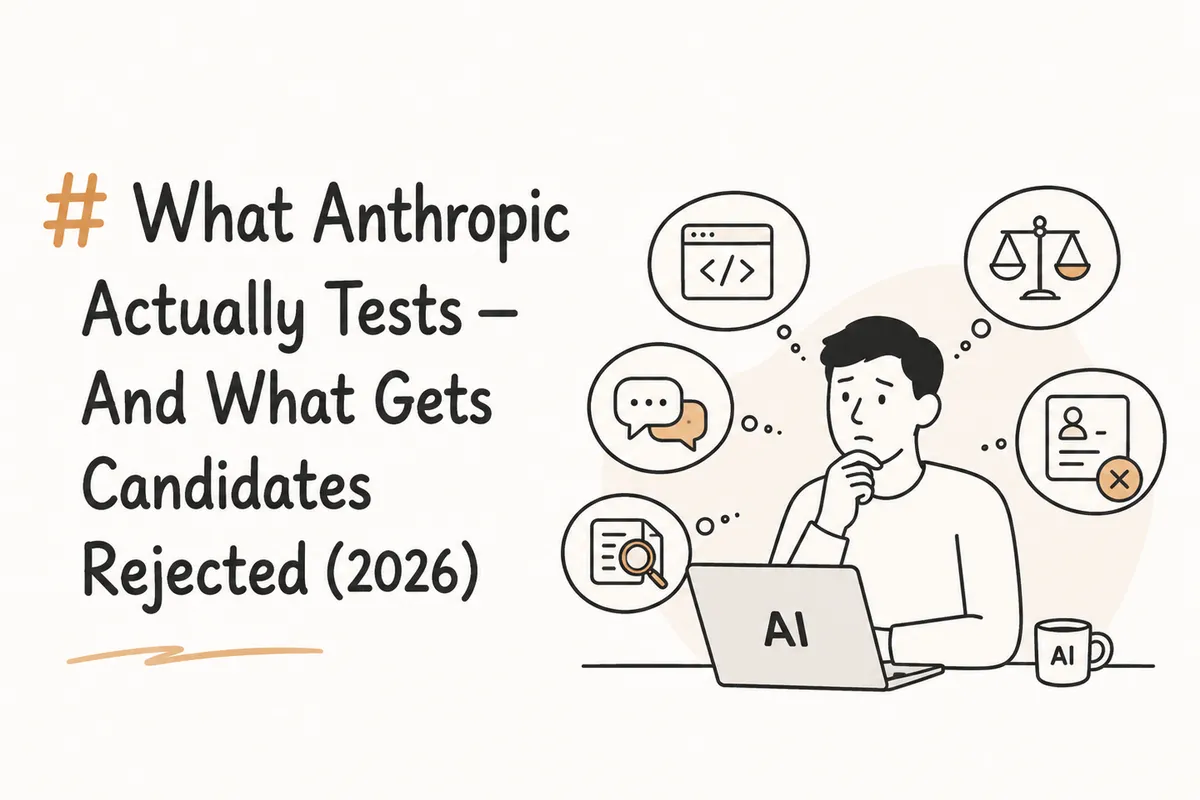
Anthropic rejects more technically-passing candidates in the culture round than in any technical stage, and the dominant failure mode is not values disagreement. Candidates who articulate thoughtful, well-reasoned professional values fail consistently when those answers would pass equally well at any other tech company.
What They Actually Evaluate
Based on candidate-reported experiences analyzed by Hack2hire
Concurrency and Library Fluency
Library knowledge is the actual gate in Anthropic's coding rounds, not algorithmic skill. Candidates who can solve the surface problem without PIL/Pillow or Python concurrency primitives run out of time before completing follow-ups: the questions are designed to require them, and there is no workaround using standard data structure knowledge alone.
Proactive testing carries explicit weight alongside the solution. Interviewers evaluate whether candidates run tests, narrate their reasoning, and verify edge cases throughout the problem. A candidate who solves the problem silently scores lower than one who shows visible reasoning on an incomplete solution.
Anthropic-tagged questions covering this area are at hack2hire.com.
Written System Design Reasoning
Unlike most system design rounds, Anthropic's Prompt Playground round runs as a written Google Doc discussion with no diagrams expected or evaluated. The evaluation rewards typed reasoning depth on requirements, schema design, and scaling. Diagram completeness and breadth of systems covered are not evaluated.
Interviewers in this round drive pacing aggressively. Candidates who defer to the interviewer's rhythm report dropping key depth on requirements and scaling before the session ends. Holding your own structure against interviewer-led redirection is the actual criterion being assessed, not fluency with any particular system.
Anthropic-Specific Values Alignment
Most late-loop rejections happen here, after candidates pass both coding and system design. The failure mode is framing: answers that align with thoughtful professional values, such as "I care about responsible AI" or "I value technical rigour", fail consistently because they would pass equally well at any serious tech company.
Interviewers are consistently difficult to read, and candidates report finishing the culture round without knowing whether their answers landed. The evaluation requires naming a specific Anthropic value, demonstrating personal history with it through a concrete example, and applying critical thinking about Anthropic's own tradeoffs rather than its stated mission.
Sustained Challenge Defense
The project retro round opens with a 20-minute presentation that Anthropic expects candidates to drive without prompting. The challenge phase that follows targets every detail of the presented project, with interviewers returning to aspects the candidate moved past quickly.
Candidates who rehearsed only the forward presentation without adversarial preparation lose depth midway through questioning. The HM round compounds this: the interviewer can appear cold or disengaged, and poor team fit at this stage can block an offer regardless of strong prior-round performance.
What They Don't Test
- Pure data structures and algorithm theory without library application: Anthropic's coding questions require PIL/Pillow and concurrency primitives; standard LeetCode preparation does not transfer
- Whiteboard or diagram-based system design: Anthropic's Prompt Playground round is a written Google Doc discussion; visual design preparation is misaligned with the evaluation criteria
- Broad system design coverage: SD interviewers go deep on one topic's requirements, schema, and scaling rather than testing breadth across systems
- Generic values alignment that would pass anywhere: culture interviewers are specifically not looking for professional norms; answers must be grounded in Anthropic's specific tradeoffs
The Real Filter
The culture round is where most Anthropic processes end for technically-qualified candidates. Reported outcomes show a consistent pattern: candidates who describe their preparation as technically strong, then receive rejections 2 to 3 days after the onsite. The rejection emails arrive too late to be technical round failures (those come within 24 hours), which places the exit at culture or HM.
The gap is not values disagreement. Candidates who fail the culture round typically hold views compatible with Anthropic's mission. The gap is between alignment-as-stated and alignment-as-demonstrated: the round requires showing where your values have conflicted with something and what you chose, not stating that you hold the right values.
Data Source
Based on 15 firsthand interview reports collected April 2026.
FAQ
Is Anthropic a good place to work as a software engineer?
Candidate reports describe a research-driven environment where engineering decisions are structured around AI safety considerations. Interviewer quality is consistently described as strong. Candidates who clear the technical rounds describe a culture that rewards first-principles thinking over pattern-matching.
What is Anthropic's engineering culture like?
Anthropic's engineering culture is research-oriented and mission-driven. The behavioral evaluation probes for values grounded in Anthropic's specific mission rather than generic professional norms. Generic alignment with broad professional values fails the culture round consistently.
How hard is it to get a job at Anthropic?
Passing the technical rounds does not guarantee an offer. The culture round is an independent elimination gate for technically-qualified candidates: rejections arriving 2 to 3 days after the onsite correlate with culture-stage failures, while technical failures arrive within 24 hours.
What is the hardest round in the Anthropic interview?
The culture round is the modal exit point for technically-qualified candidates. It evaluates values alignment through concrete examples of past tradeoffs, not through stated values. Answers that would pass a generic professional culture screen fail Anthropic's culture round when they don't engage with the company's specific mission tradeoffs.
Anthropic-specific question patterns are indexed at hack2hire.com.