

What Airbnb Actually Tests — And What Gets Candidates Rejected (2026)
Data from firsthand reports reveals what the process actually selects for
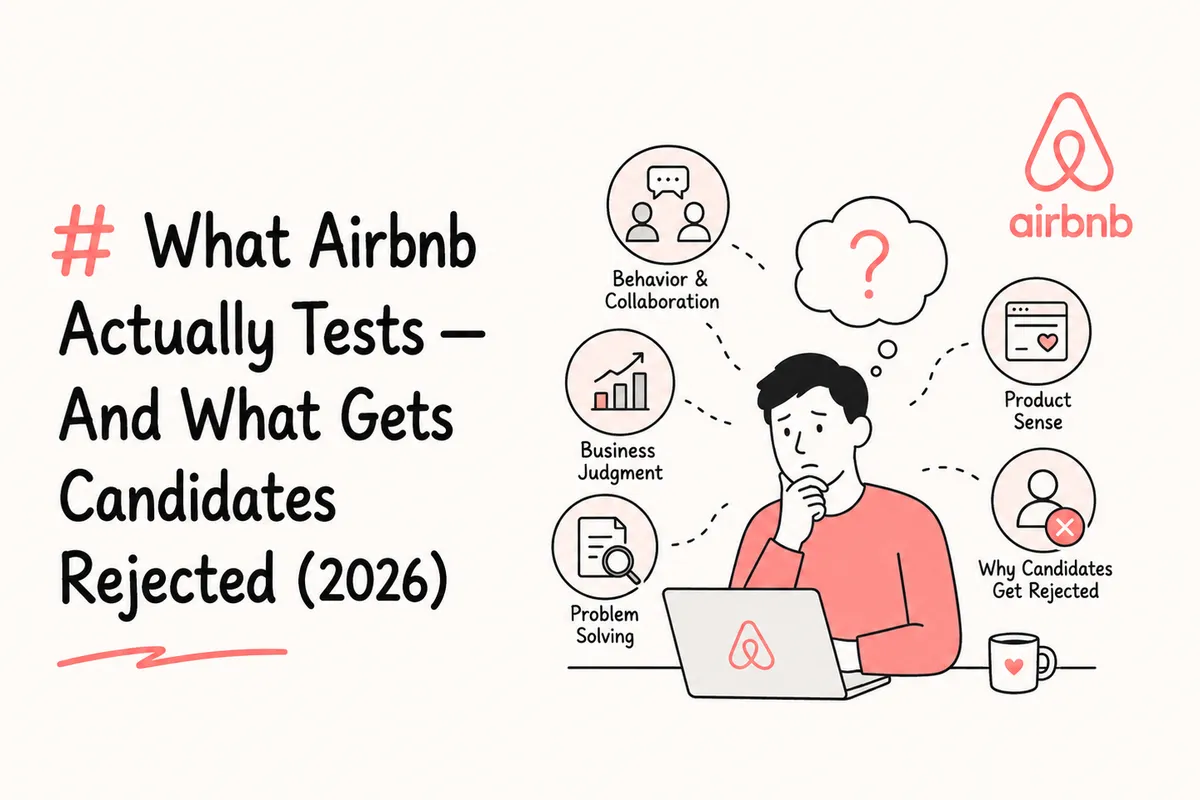
At Airbnb, the deep dive evaluates background fit as an independent criterion that overrides strong coding and system design performance: candidates are rejected there not for technical gaps but for role mismatch, and the outcome cannot be predicted from how earlier rounds went. The pattern extends across all evaluation stages: each round has a separately weighted component that determines pass or fail independent of overall performance.
What They Actually Evaluate
Based on candidate-reported experiences analyzed by Hack2hire
Coding Execution: Time Allocation Across All Three Components
Candidates who produce correct solutions but do not leave time for test cases fail the Airbnb coding evaluation. Test case writing is required, not optional, and is assessed as a separate component within the same time window as coding, debugging, and edge case handling. The phone screen and virtual onsite coding rounds share this structure: 45-60 minutes for a single problem that must produce a working solution covering edge cases and including written test cases before time runs out. Candidates who spend most of the window on implementation quality consistently run out of time before meeting the test case requirement.
System Design: Schema Completeness and Communication Quality
Airbnb's system design round scores communication style as heavily as technical correctness. Data schema completeness is weighted as a primary evaluation artifact alongside overall architecture. Candidates who produce technically valid high-level designs but do not articulate reasoning throughout the design session report weaker evaluations than candidates who reason verbally and produce a complete schema. The evaluation targets discussion quality throughout the session, not only the final design: interviewers assess how candidates think through decisions and handle constraints, and how specifically they commit to schema. Candidates who defer schema design to focus on architectural breadth, or who do not verbalize reasoning as they design, report being redirected and evaluated on their communication rather than their technical output alone.
Deep Dive: Explanation Conciseness and Background Fit
Unlike coding and system design, where technical output is at least partially decisive, the deep dive at Airbnb evaluates two axes that are independent of implementation quality: explanation conciseness and background fit with the role. Background fit is assessed as a separate criterion, and candidates who passed coding and system design are rejected at the deep dive when a background mismatch is identified, regardless of how technically sound their project presentation was. Explanation conciseness is the other evaluated axis. Candidates who spend more than 20 minutes on a single project, or who over-explain without abstracting for an interviewer who may not share their domain background, are rejected even after strong technical round performance. Project complexity does not substitute for clarity: interviewers consistently evaluate how well candidates simplify, not how sophisticated the underlying work was.
Core Values and Open-Ended Reasoning (MLE roles)
The core values round uses open-ended behavioral questions focused on personal motivations and causes, distinct from LP-format questions used at most companies. A separate ML practice round follows a discussion format on product and modeling problems, with no single correct answer expected. Both rounds appear in MLE pipelines and not consistently in SWE interviews, and interviewer chemistry carries weight alongside reasoning quality in how these rounds are evaluated.
Airbnb-tagged questions covering these evaluation areas are at hack2hire.com.
What They Don't Test
- Solution correctness alone: test case writing and edge case handling are separately scored components within the same time window, and time management across all requirements determines pass or fail as much as whether the solution is correct
- System design architectural breadth without schema depth: data schema completeness is weighted as a primary evaluation criterion, not a secondary concern to overall architecture
- Technical performance in isolation at senior levels: the deep dive evaluates background fit as an independent overriding criterion, and strong coding and system design scores do not protect against rejection there
- Project complexity or depth of prior work: explanation conciseness and abstraction quality are what the deep dive actually measures; over-complex or over-long project presentations are a common rejection trigger even after clean technical rounds
- LP-style behavioral questions for SWE candidates: core values and ML practice rounds appear in MLE pipelines and not consistently in SWE interviews; the format differs structurally from standard behavioral evaluations
The Real Filter
The most common failure at Airbnb's virtual onsite is not technical inability: it is strong technical performance that does not transfer to the round-specific evaluation axes. In coding, candidates with correct solutions run out of time before completing the required test cases. In system design, valid architectures receive weaker evaluations when candidates did not articulate reasoning throughout the session, a communication failure rather than a technical one. Deep dive rejections follow a different pattern entirely: candidates who passed both earlier rounds are rejected on background fit before technical quality is assessed. Each gate operates independently: a candidate can pass two of the three and still not receive an offer because the failing round has its own threshold that does not average with earlier performance.
Data Source
Based on 6 firsthand interview reports, collected in 2026. Data confidence is medium: patterns are directionally supported but may not be fully representative.
FAQ
Is Airbnb a good place to work as a software engineer?
Candidate reports describe a technically demanding environment where communication quality is weighted alongside correctness throughout the interview. The deep dive round, which can extend to 90 minutes, reflects an expectation that engineers can abstract and defend past technical decisions for non-domain audiences.
What is Airbnb's engineering culture like?
Airbnb's engineering culture places emphasis on project ownership and cross-domain communication. System design rounds evaluate verbal reasoning as heavily as technical correctness, scoring articulation throughout the session as an independent criterion from the final architecture.
How hard is it to get a job at Airbnb?
Strong coding and system design performance does not guarantee an offer. Background fit in the deep dive round and communication quality throughout system design are each evaluated independently and can override strong technical performance in other rounds.
What gets candidates rejected at Airbnb?
The most common rejection patterns are running out of time before writing test cases (test-writing is a required component in coding rounds, not optional) and background mismatch in the deep dive round. Candidates who over-explain or spend more than 20 minutes on a single project in the deep dive are rejected even after passing coding and system design.
Airbnb-specific question patterns are indexed at hack2hire.com.