

Databricks Interview Process: Rounds, Format & Timeline (2026)
Round-by-round breakdown, timeline, and what candidates actually report
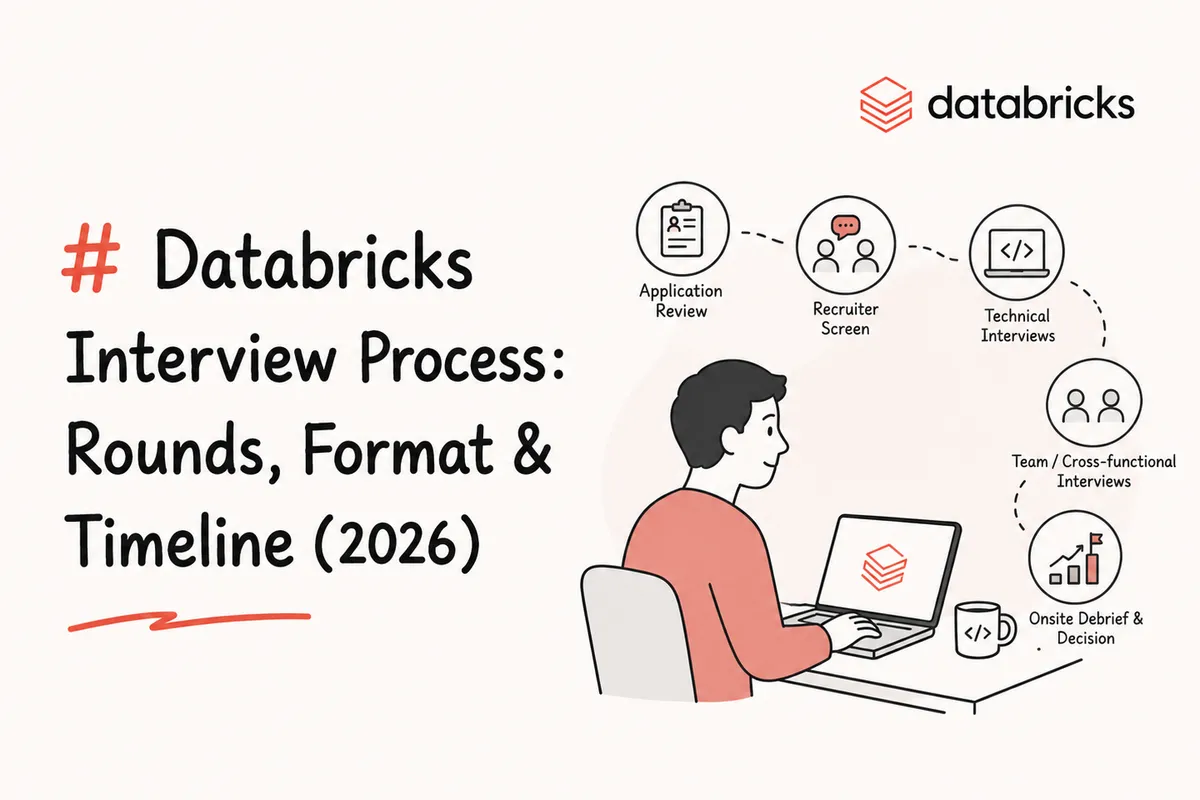
Databricks runs a phone screen followed by a 4 to 5 round virtual onsite, but clearing every round with "strong hire" still doesn't guarantee an offer. The hiring committee reviews the full package independently and has been reported to reject candidates whose individual round ratings were uniformly positive. The HC review is a distinct final gate that operates outside the standard round feedback loop.
At a Glance
| Round | Duration | Format | Notes |
|---|---|---|---|
| Phone Screen | 45 to 55 mins | Algorithm, networking/infra, or API design | Format varies by team; not disclosed in advance |
| Coding / Algorithm (Round 1) | 45 mins | Algorithm and data structures, complexity analysis | Hard difficulty level |
| Coding / Algorithm (Round 2) | 45 mins | Optimization follow-ups and edge cases | Time management is evaluated |
| System Design | 60 mins | Distributed systems design | Full design sequence; senior loops may add a second round |
| Behavioral | 45 mins | 4 to 5 topics, 2 to 3 short questions each | Breadth over depth format |
Round-by-Round Breakdown
Phone Screen
The Databricks phone screen runs 45 to 55 minutes, but the format varies by team and is typically not disclosed before the call. Three tracks have been reported: algorithm and data structures, networking and infrastructure, and API design. The networking track is distinct from standard algorithm preparation, testing binary operations and prefix matching logic including CIDR range concepts; candidates who encountered this format without covering that material reported running out of time before completing the problem. The API design track focuses on schema decisions at a smaller scope, including field selection and how the system handles load at volume. No response for a week or more after the phone screen is common at Databricks. Candidates who followed up with their recruiter during this period of silence have successfully advanced to the onsite, and the ghosting pattern is not a reliable signal of final rejection.
Coding / Algorithm Rounds
Two coding rounds appear in the virtual onsite, each 45 minutes, with different interviewers. Both rounds expect a working implementation with complexity analysis and proactive edge case discussion alongside the code. Optimization follow-ups are standard: a correct initial solution is typically followed by a variant requesting improved time or space complexity, or a constrained version of the original problem with an added requirement. The evaluation covers the full session from framing through implementation and post-implementation testing. Candidates who finished implementing but did not reach the testing phase reported this as a factor cited in their assessments. In multiple reported rejections, the specific failure point was a follow-up sub-problem involving ordering constraints or duplicate handling, not the initial base problem.
System Design
At 60 minutes, this round covers distributed infrastructure and application systems. Reported topics span communication infrastructure, file storage and syncing, payment systems, and business-oriented API design. Interviewers have covered the full design sequence in reported sessions: functional requirements, non-functional requirements, capacity estimation, API and schema design, and fault tolerance and scaling strategy. The depth of trade-off probing increases for senior and staff candidates. Those applying at senior or staff level may also face a second architecture round added to the standard structure, bringing the total virtual onsite to five rounds.
Behavioral
The behavioral round at Databricks runs 45 minutes and covers 4 to 5 topics, with 2 to 3 questions asked within each. The format is breadth-oriented. The interviewer cycles through multiple themes in a single session rather than spending the full time reconstructing one extended narrative. Topics reported include handling conflicts, the hardest professional challenge, the biggest professional mistake, and feedback the candidate received and disagreed with. Long answers to early topics leave later ones uncovered.
Timeline & Results
Post-onsite response times at Databricks split into two patterns. Fast outcomes deliver a decision within a few days of completing the virtual onsite. Slow outcomes involve multi-week silence, and candidates who eventually received offers frequently reported getting a response only after proactively following up with their recruiter.
The hiring committee convenes after all interviewers have submitted ratings and reviews the complete file independently of those ratings. Candidates report HC weighing years of experience and current-company standing alongside round performance. Candidates applying from large technology companies have been asked to provide internal performance review documentation before a final decision was reached. Interviewers did not disclose this request at the start of the loop; some candidates described it as an early indicator that the loop would not result in an offer.
- Application / recruiter screen
- Phone screen: 45 to 55 minutes; format varies by team (algorithm, networking/infrastructure, or API design)
- Virtual onsite: 4 rounds standard (2 coding, 1 system design, 1 behavioral); 5 rounds for senior and staff loops
- Hiring committee review: timeline ranges from a few days to several weeks; proactive follow-up is required for most candidates
Data Source
Based on 17 candidate-reported interview experiences, primarily from 2025 Q4 through 2026 Q2.
FAQ
How many rounds is the Databricks interview?
The standard process runs 5 rounds total: a phone screen plus a 4-round virtual onsite covering two coding rounds, one system design round, and one behavioral round. Senior and staff candidates may encounter a fifth virtual onsite round if a separate architecture round is added to the loop.
Does Databricks do a phone screen before the onsite?
Yes. A 45 to 55 minute phone screen precedes the virtual onsite. The format varies by team and role: algorithm, networking/infrastructure, or API design. The format is typically not communicated to candidates before the call.
How long does the Databricks interview process take from application to offer?
Post-onsite decisions have been reported as fast as a few days and as slow as several weeks. Most candidates need to follow up with their recruiter to get a response rather than waiting passively, and extended silence at either stage does not reliably indicate rejection.
Can you pass all Databricks interview rounds and still get rejected?
Yes. The hiring committee reviews the complete candidate file after all interviewers submit feedback, and it operates independently of individual round ratings. Candidates who received "strong hire" ratings from every interviewer have reported HC rejections, often attributed to experience-level concerns or current-company performance standing.
Databricks-specific coding question patterns are indexed at hack2hire.com.