


DoorDash is considering whether merchants should configure promotions themselves or let the platform configure them automatically. Manual setup can preserve local judgment but takes time. Automation can reduce that work, while also spending money on orders that would have arrived anyway. The evaluation needs to connect merchant control and profitability with consumer value and marketplace effects.
1. Which promotion decisions should be automated?
What are the benefits, drawbacks, and trade-offs of merchant-configured and automatically configured promotions? What would you clarify before recommending how much control the platform should take?
Clarify the objective and who pays before choosing the interface. A useful starting proposal is optional automation within merchant-approved limits, tested against the existing merchant-configured process. Its value depends on whether it saves effort and improves contribution without taking decisions the merchant does not want to delegate.
What does the platform know that merchants do not?
Merchants may know their margins, staffing, inventory, and which items they want to promote. The platform may observe broader demand, discovery, and delivery conditions. Neither side necessarily observes the other's full costs. An automated policy that sees completed orders but misses preparation costs can choose a promotion that looks successful while making the merchant worse off.
Ask which decisions are being delegated: discount depth, eligible items, audience, timing, budget, or the entire campaign. Clarify funding, fees, current promotion availability, and the merchant's objective. Filling spare capacity differs from acquiring repeat customers or clearing inventory. A merchant already at capacity may prefer fewer discounted orders even when total demand could increase.
Automation should therefore be evaluated as a specified product, not as an unspecified algorithm. The following are credible alternatives under different merchant needs:
Merchant-configured promotions
Let merchants choose the offer, items, schedule, and budget. Clear previews and simple defaults can reduce setup work without transferring the spending decision. This is attractive when merchants have unusual margins, temporary inventory needs, or strong preferences the platform cannot reliably observe.
The cost is effort and inconsistent execution. A merchant may miss a useful demand opportunity or choose an offer without understanding its economics. Retaining this approach can be reasonable when local information dominates. Its benchmark should include setup time and mistakes, rather than treating manual control as free or assuming low adoption means no demand.
Optional automation within merchant limits
Let merchants opt into automatic configuration after seeing the funding rules, eligible inventory, discount limits, and spending cap. Allow them to pause or override the policy and inspect what it did. This can remove repeated setup while preserving the business constraints that determine whether an offer is acceptable.
Test this as the working proposal when setup burden is meaningful and those constraints can be enforced. It still depends on useful demand estimates and trustworthy cost information. Merchants may decline or override it, so success is the value of offering this product, including participation, rather than the performance of a selected group that adopts it.
These are proposed designs, not claims about current company practice. If mandatory automatic spending is the intended product, say so explicitly. Its comparison includes the loss of merchant choice and resulting churn, not just an easier campaign builder.
2. How would you measure promotion value?
Which merchant, consumer, and marketplace metrics would define success? How would you distinguish useful growth from subsidized orders, lost merchant margin, or other negative effects?
Measure merchant contribution after the promotion's costs, consumer experience and repeat value, and marketplace contribution after funding and fulfillment costs. Keep redemption and adoption as mechanism measures. Neither establishes incremental demand, and a merchant-level gain can still come from moving an order away from another merchant.
When can a redeemed order lose money?
TIP
The Python cells in this case study run in your browser and share one session. Click Run on each cell from top to bottom. If you change an earlier input, rerun that cell and the later cells that depend on it.
Consider a hypothetical offer with 600 redeemed orders. Each order contributes $8 before this offer's discount, and the merchant pays $3 per redemption. Assume 1/3 of redeemed orders would not have occurred without the offer. Other orders, baskets, and costs are unchanged.
Only incremental orders add the pre-discount contribution. Every redemption receives the discount, including orders that would otherwise have paid the undiscounted price:
redeemed_orders = 600
contribution_before_discount = 8
merchant_discount = 3
incremental_share = 1 / 3

incremental_orders = redeemed_orders * incremental_share
added_contribution = incremental_orders * contribution_before_discount
discount_cost = redeemed_orders * merchant_discount

net_incremental_contribution = added_contribution - discount_cost
break_even_share = merchant_discount / contribution_before_discount

print(f"Incremental orders: {incremental_orders:.0f}")
print(f"Added contribution: ${added_contribution:,.0f}; discount cost: ${discount_cost:,.0f}")
print(f"Net incremental contribution: ${net_incremental_contribution:+,.0f}")
print(f"Break-even incremental share: {break_even_share:.1%}")
Incremental orders: 200
Added contribution: $1,600; discount cost: $1,800
Net incremental contribution: $-200
Break-even incremental share: 37.5%
| Conditional calculation | Value |
|---|---|
| Incremental orders | 200 |
| Added contribution before discounts | $1.6k |
| Merchant-funded discount cost | $1.8k |
| Net incremental merchant contribution | -$200 |
| Break-even incremental share | 37.5% |
The offer loses $200 under these assumptions despite its redemptions. At break-even, incremental contribution exactly covers discounts on all redeemed orders. The curve shows how the conclusion changes when the unknown incremental share changes:
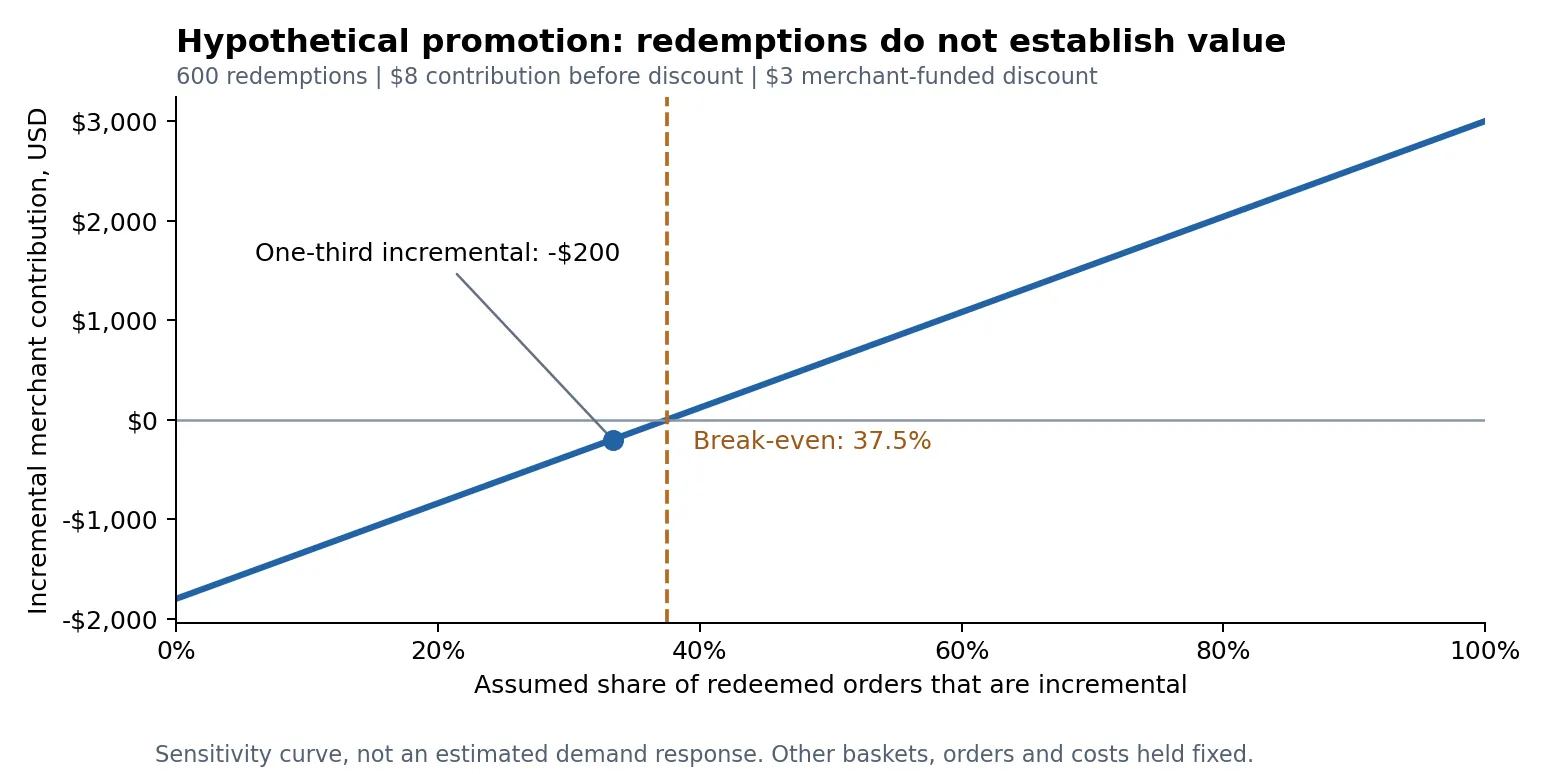
Merchant contribution depends on incrementality, not redemption volume alone
The horizontal axis is an assumed share, not an estimated response to changing the offer. At 37.5%, net incremental contribution reaches zero. Greater discounts, lower item margins, changing baskets, or additional displacement outside these redeemed orders can change the calculation.
IMPORTANT
Redemption logs do not reveal which purchases would have happened without the offer. The 1/3 incremental share is a hypothetical assumption. This accounting example explains what must be measured, without estimating the effect of automation or comparing the full manual and automatic policies.
For the full comparison, include each policy's existing promotions, merchant labor, refunds, and funding arrangements. Do not count the same subsidy as a new benefit to every stakeholder. A platform-funded discount can improve merchant contribution while reducing platform contribution, so record the transfer and the total cost separately.
Which outcomes prevent a misleading win?
Use a fixed eligible-merchant cohort and a defined follow-up period. If merchant contribution is not observable, estimate it from agreed cost inputs and report sensitivity. Sales can remain an observed outcome, but should not be relabeled as profit.
| Stakeholder | Value to assess | Guardrail or failure to detect |
|---|---|---|
| Merchant | Contribution per assigned merchant and setup effort | Overspend, loss-making orders, overrides, complaints and churn |
| Consumer | Useful fulfilled orders and repeat ordering | Misleading offers, cancellations, fees and poor service |
| Marketplace | Total contribution after subsidies and fulfillment | Demand shifted between merchants or borrowed from later periods |
| Delivery participants | Workload and completed deliveries | Delays, cancellations and earnings deterioration |
Track distribution as well as averages. A policy can help high-margin merchants while repeatedly harming smaller or capacity-constrained businesses. Define these groups before treatment using information the policy cannot change. Consumer repeat behavior should include a period after the discount, otherwise repeated subsidized ordering can appear to be durable demand.
Marketplace measurement must cover nonparticipating merchants in the affected areas. If treated merchants gain orders while neighbors lose the same orders, the product may redistribute demand without increasing total demand. That can still be a deliberate policy choice, but it is not evidence of new marketplace value.
3. How would you test the promotion policies?
Design an experiment comparing the approaches. How would you choose the randomization unit, handle merchant participation, and interpret the results when merchants compete for the same consumers? What evidence would support expanding automation?
Separate the effect of offering automation from the effect of adoption. Start with a concurrent comparison at the merchant-business level when the goal is to test the offer and its usability. If marketplace substitution materially changes the target decision, use a design that also varies exposure across meaningful market groups before interpreting the result as a full-rollout effect.
Why not compare adopters with nonadopters?
Merchants who adopt may have more spare capacity, better margins, or more experience with promotions. Those traits can affect later orders even without automation. More orders among adopters therefore cannot isolate what the product caused.
Define eligible businesses before assignment, linking outlets under a shared promotion decision. Randomly offer bounded automation to treatment while control keeps the existing merchant-configured process. Keep both arms' budget constraints and funding opportunities specified before assignment. Actual spending is part of the product effect, so do not equalize it afterward by dropping expensive treatment campaigns.
Retain every assigned business in the primary comparison, including merchants who decline the offer or launch no campaign. This estimates the effect of making automation available under its actual participation conditions. Adoption, time to setup, override frequency, and results among users help diagnose delivery and demand. They do not turn a selected adopter comparison into a randomized effect.
If the decision instead concerns mandatory automatic spending, or only merchants who have already consented, define that eligible population and treatment before randomization. The estimand changes with that choice. An optional offer experiment cannot establish how businesses would respond to losing the option.
When is merchant assignment insufficient?
Competing merchants share consumers and delivery capacity. A treated offer can take an order from a control merchant, or increase delivery demand enough to affect both. Stable merchant assignment avoids mixing configuration experiences within a business, but cannot make those market interactions disappear.
For broader marketplace effects, group comparable delivery areas using pre-period consumer overlap and randomly vary the policy across groups, or vary the fraction of eligible merchants offered automation within areas. Include outcomes for all merchants and consumers in each area. Check cross-boundary ordering, shared delivery resources, and unequal market sizes before treating the groups as isolated units.
Randomizing geographic periods can help with short-lived market effects, but a quick switchback is a poor default for persistent merchant learning or repeat-purchase behavior. Earlier promotions may change later demand. Use a horizon and assignment that can capture the mechanism, with inference based on the actual randomized units. More orders do not create more independent experimental markets.
What evidence would justify expansion?
Plan sample size using variation at the chosen assignment unit, a worthwhile contribution gain, and agreed harm tolerances. Follow long enough to observe setup, spending, fulfillment, and post-discount return. No universal duration or sample size follows from the redemption example. Prespecify analysis timing and key merchant groups, rather than stop after a favorable revenue spike.
Before a decision, reconcile assignment, delivered policy versions, budget enforcement, funding and fee ledgers, refunds, and complete outcome windows. A missing discount cost can manufacture a profit gain. Examine any merchant benefit alongside total area demand and contribution to distinguish new value from substitution.
Expand when the offer delivers worthwhile value after all relevant costs, merchants retain the agreed control, and consumer and delivery guardrails are met with adequate precision. Hold or narrow the policy when gains require excessive discounts, merchant opt-outs, or congestion. A successful optional pilot supports that offer at the tested exposure, while broader rollout still needs evidence about marketplace interactions and sustained merchant behavior.
4. Wrapping up
Promotion automation is valuable when it reduces work while improving the economics merchants actually face. Merchant control is part of that product, not merely a setting to remove. The conditional example shows why redemptions can coexist with a loss: discounts also subsidize orders that would have occurred anyway.
Carry that distinction into the experiment. Compare the randomized offer across all assigned businesses, then assess whether marketplace gains survive substitution, funding costs, and delivery pressure. The strongest recommendation is conditional on contribution, informed participation, and the behavior of the surrounding market, rather than on the number of campaigns the platform can launch.