


A delivery marketplace is evaluating a Top Dasher program that gives benefits to qualifying delivery workers. Such a program could encourage reliable service, but it could also reward workers who would already perform well or move attractive work away from everyone else. The particular benefits and qualification rules are unspecified, so the evaluation must begin with that contract.
The task is to assess the program's value and drawbacks, define success, choose an experimental unit, and explain a result in which the treatment group's primary metric is lower than control's.
1. What value could the program create?
What benefits and drawbacks could a Top Dasher program create for delivery workers, consumers, merchants and the marketplace? What would you clarify about the benefits and qualification rules before evaluating it?
The program creates value if its incentives change useful behavior or participation enough to improve service after accounting for cost and effects on other workers. A benefit received by a qualifying worker is not, by itself, evidence of an incremental marketplace gain.
Which part of the program changes worker behavior?
Specify what workers receive, what they must do to qualify, when status is earned and renewed, and what happens when they lose it. A financial reward, more convenient access, and priority for scarce offers create different incentives and costs. These are possible benefit types, not assumed features of the program.
Ask what outcome the program is meant to improve. If the problem is unreliable fulfillment, a reward should make useful availability or reliable completion more attractive. If the goal is retaining workers, define the horizon and the participation the marketplace needs. A short activity spike before qualification may have little value if it disappears immediately afterward.
Qualification also changes the comparison. Workers who meet a performance rule may already be more experienced, available at different times, or serving easier routes. Comparing status holders with everyone else mixes program effects with those differences. Randomize access to the policy before the behavior it is intended to change.
Where could the incentives create a cost elsewhere?
Trace each proposed benefit through the marketplace:
| Participant | Possible value | Possible cost |
|---|---|---|
| Qualifying workers | More useful work or a valued reward | Effort, uncertainty or pressure to chase status |
| Other workers | Better overall demand or service conditions | Loss of desirable offers or future participation |
| Consumers | More reliable fulfillment | Higher cost or worse coverage outside rewarded tasks |
| Merchants | Fewer failed handoffs and more completed orders | Uneven service across locations or hours |
| Marketplace | Useful capacity and durable service | Reward cost, displacement and gaming |
The qualification rule can create its own failure. If a threshold rewards a narrow activity measure, workers may optimize that measure while neglecting delivery quality or less attractive areas. Inspect behavior around qualification boundaries and renewal dates. A jump near a cutoff is a diagnostic pattern, not proof that workers are manipulating the program.
A program can still be worthwhile when some work shifts between workers. The question is whether the resulting service, worker experience and economics satisfy the stated objective. Do not assume that every redistribution is harmful or that a rewarded group's improvement settles the decision.
2. How would you measure program success?
Which success and guardrail metrics would you use to determine whether the program creates value, rather than merely shifting work or rewards between delivery workers?
For a fulfillment objective, measure total mature completed orders per fixed marketplace opportunity, such as a prespecified market-hour. Then check cost, delivery quality and the distribution of worker outcomes. Use qualification, benefit use and individual activity to explain the result rather than substitute for marketplace value.
Which denominator survives the program's response?
Define geography, operating hours, order attribution and outcome maturity before testing. Count distinct completed orders across all workers in those fixed windows. Normalize unequal opportunity time consistently. Do not divide only by workers who remain active after treatment or by offers accepted after the program changes acceptance.
A completion rate among placed orders is useful, but it can rise while fewer orders are placed or served. Report completed volume beside it. If the business objective is contribution rather than fulfillment, specify revenue, reward and service costs over the same opportunity instead of assuming more orders are profitable.
Keep the scorecard connected to the program's mechanism:
- Service: completion, cancellation, lateness and consumer/merchant experience, using mature outcomes and stable definitions.
- Worker experience: earnings and useful participation across assigned workers, plus earnings per active hour as a diagnostic with its changing population visible.
- Economics: incremental reward and operating costs, contribution and whether attractive orders move between workers or neighboring markets.
- Persistence: participation through the qualification and benefit cycle, with follow-up for a temporary rush or later exit.
IMPORTANT
Keep analysis groups fixed before treatment. Workers who earn status after assignment are a selected outcome of the program. They cannot replace the full assigned population when estimating the policy's effect.
Choose a practically useful improvement and harm tolerances before results arrive. A worker-retention objective could justify a different primary outcome, but that choice must precede looking for the metric on which treatment wins.
3. How would you assign the program experiment?
What unit of randomization would you choose to evaluate the program, and how would the benefits, qualification rules and interactions between workers affect that choice?
Choose the unit from the policy's effect on shared work. A worker-level offer trial can answer a direct-access question when spillovers are acceptably small. If benefits change access to scarce offers or shared delivery supply, evaluate the marketplace policy across sufficiently separate service catchments, including all workers and orders affected by it.
Use the current policy as control and specify the proposed qualification-and-benefit policy in treatment. Keep other rules fixed where feasible. Any additional changes belong in the treatment definition, since the test cannot separate their effects merely by calling the bundle a benefit program.
What effect would a worker split actually estimate?
Suppose the benefit gives qualifying workers access to scarce opportunities. Giving that benefit to one worker can change the offers received by another. The worker-level contrast then reflects the tested allocation of access, including competition with controls. It need not equal the effect of running the qualification program throughout a market.

Shared offers connect worker access to the surrounding market
The green boundary marks where access or the policy is assigned. In the market-policy version, both workers belong to the evaluated market, even if only one eventually qualifies. The larger boundary helps align the outcome with shared work, while worker movement and cross-market demand still require checks.
The following designs answer progressively different questions:
Bad Solution: Compare status holders with other workers
Compare completed orders or earnings for workers who achieved status with those who did not, then attribute the gap to the program. This is inexpensive because the groups already exist, and it may produce a persuasive dashboard showing that successful workers perform better.
Qualification is related to behavior, opportunity and experience that can also affect the outcome. The program may additionally change who crosses the threshold. This comparison cannot separate those selection effects from the benefit. It is useful for describing status holders, but it does not estimate what offering the policy would change.
Good Solution: Randomize access for a direct worker question
Assign access to the program among a population fixed before treatment, and compare all assigned workers over the same follow-up. This removes the need to choose participants based on status they earn afterward. It can answer a direct-access question when the benefit has little effect on the opportunities or behavior of other workers.
If access changes shared offers, the control experience also changes. The contrast then belongs to that allocation, not a whole-market adoption policy. Keep this design when its narrower question is useful and spillovers are limited, rather than presenting it as an automatic marketplace evaluation.
Great Solution: Test the shared-market policy in catchments
For benefits that change shared work, assign the complete policy across service catchments with limited worker movement and demand overlap. Match or group catchments on pre-period conditions before random assignment. Measure the marketplace primary and worker guardrails across each assigned catchment, including workers who never qualify.
This better aligns assignment with the system the policy changes, but it reduces the number of independent comparisons. Inspect boundary movement and displaced work. The design is preferred for this shared-market branch only when enough sufficiently separate catchments exist. A geographic label does not establish independence or adequate precision.
Why might a short switchback miss the program effect?
Switching a benefit on and off does not reset earned status, expectations or future work schedules. If those responses persist, outcomes in a control interval can still reflect earlier access. A short temporal comparison may therefore miss the program's durable effect even if it works for an immediate dispatch change.
Use persistent assignment through the relevant qualification and benefit cycle when that is the target. A switchback needs evidence that carryover becomes negligible within its prespecified analysis window. If only a small number of connected catchments is available, broaden the feasible experiment or narrow the conclusion instead of counting individual orders as independent units.
Prespecify the target and market weights, especially when catchments differ in size. Base weights on the intended business population or pre-period opportunity, not treatment outcomes. Plan precision from independent catchment variation and the useful effect size. Audit assignment, eligibility rules, benefit delivery and outcome logging before interpreting a negative result.
4. Why might treatment perform worse than control?
If the treatment group's primary metric is lower than the control group's, how would you investigate the result and decide what it means for the program?
Validate the comparison, quantify uncertainty at the assigned unit, then investigate mechanisms that could reduce the primary outcome. A negative estimate is not automatically a proven harmful effect. Nor can it be dismissed because qualifying workers appear to benefit.
Can rewarded workers gain while the market loses?
TIP
The Python cells in this case study run in your browser and share one session. Click Run on each cell from top to bottom. If you change an earlier input, rerun that cell and the later cells that depend on it.
Consider hypothetical equal-duration market windows with comparable opportunity. Label workers using a qualification rule measured before treatment and keep those labels fixed. These are accounting inputs, not observed experiment results or enough independent replicates for an uncertainty calculation. Calculate market totals before interpreting a subgroup gain:
control_orders = {"prequalified": 800, "other": 1200}
treatment_orders = {"prequalified": 960, "other": 940}

control_total = sum(control_orders.values())
treatment_total = sum(treatment_orders.values())

prequalified_change = treatment_orders["prequalified"] - control_orders["prequalified"]
other_change = treatment_orders["other"] - control_orders["other"]
market_change = treatment_total - control_total

market_change_pct = 100 * market_change / control_total
prequalified_change_pct = 100 * prequalified_change / control_orders["prequalified"]

print(f"Prequalified change: {prequalified_change:+d} orders ({prequalified_change_pct:+.1f}%)")
print(f"Other-worker change: {other_change:+d} orders")
print(f"Market total: {control_total:,} -> {treatment_total:,} orders ({market_change_pct:+.1f}%)")
Prequalified change: +160 orders (+20.0%)
Other-worker change: -260 orders
Market total: 2,000 -> 1,900 orders (-5.0%)
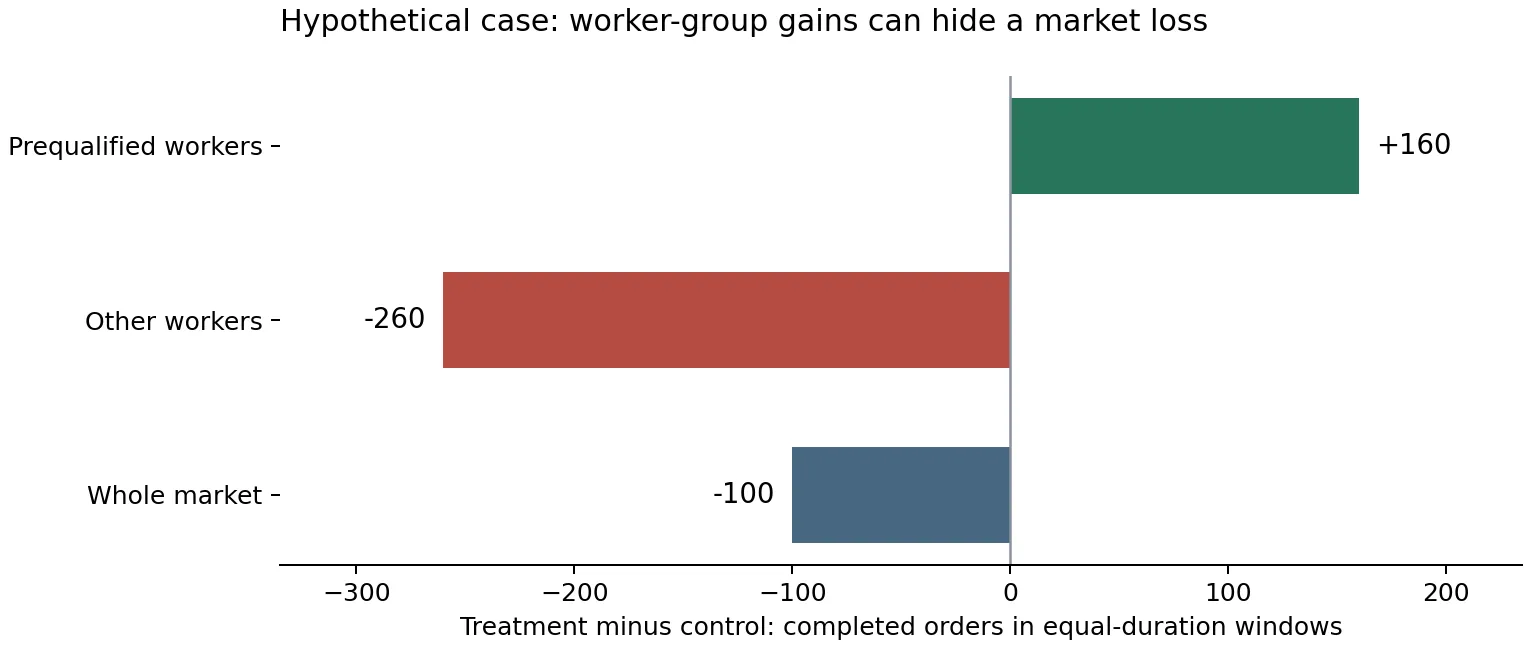
Hypothetical worker-group changes sum to a lower marketplace total
Prequalified workers complete 160 more orders, a 20% increase. Other workers complete 260 fewer. The market moves from 2k to 1.9k completions, a loss of 100, or 5%. The subgroup improvement does not establish net recovery.
The identity does not prove that priority displaced work. A demand shock, missed exposure, worker exit or a service defect could also produce these cells. Inspect the randomized-unit estimates and the events leading to the lost orders before naming a cause.
Which checks separate a real loss from a misleading result?
Begin with the experiment contract. Confirm the reported primary, fixed windows, comparable outcome maturity, assignment counts and rule versions. Inspect whether benefits were delivered as assigned. Do not remove nonrecipients or redefine qualifying status after observing the results. Estimate the effect and its interval with the original assignment and weights, including relevant dependence and any planned repeated looks.
Then investigate the path that changes:
| Pattern | Comparison to make | What it distinguishes |
|---|---|---|
| Qualifying workers gain, others lose | Offer allocation, overlap and total completions | Redistribution vs useful extra capacity |
| Availability grows, completions fall | Requested demand, assignment and service times | Idle capacity vs a fulfillment failure |
| Acceptance rises, quality worsens | Cancellations, lateness and task mix near qualification | Narrow-target response vs better service |
| Loss follows benefit delivery errors | Assigned status, actual access and version timing | Implementation failure vs intended policy |
| Neighboring markets lose activity | Worker movement and combined market outcomes | Local gain vs displaced work |
Compare these patterns with pre-period activity and the concurrently randomized controls. A post-treatment subgroup can suggest a mechanism, but its members were not randomly selected by that subgroup definition. Treat the pattern as evidence to investigate rather than a new causal estimate.
If a trustworthy interval supports a practically important loss, or a harm guardrail is breached, pause expansion and revise the mechanism. If the estimate is too imprecise, improve the planned comparison or gather the prespecified follow-up. Do not extend or stop opportunistically until a favored result appears. A confirmed delivery bug calls for a repair and a clearly defined subsequent evaluation, not a claim that the intended benefit has already been tested.
5. Wrapping up
Top Dasher should be evaluated as an incentive policy, with its benefits and qualification contract made explicit. A successful worker group can coexist with a worse marketplace outcome. Keep the full assigned population and total service opportunity visible, then use worker-level diagnostics to explain who gains and who loses.
The experimental unit follows the effect the policy can create. Direct worker access, shared-market adoption and durable participation are different targets. A lower treatment primary calls for valid uncertainty and discriminating mechanism checks, with expansion governed by useful net value and acceptable harm rather than status-holder performance alone.